
Playroom
A website that opened a games SDK to app builders, and a portal that bills by the player.
The problem
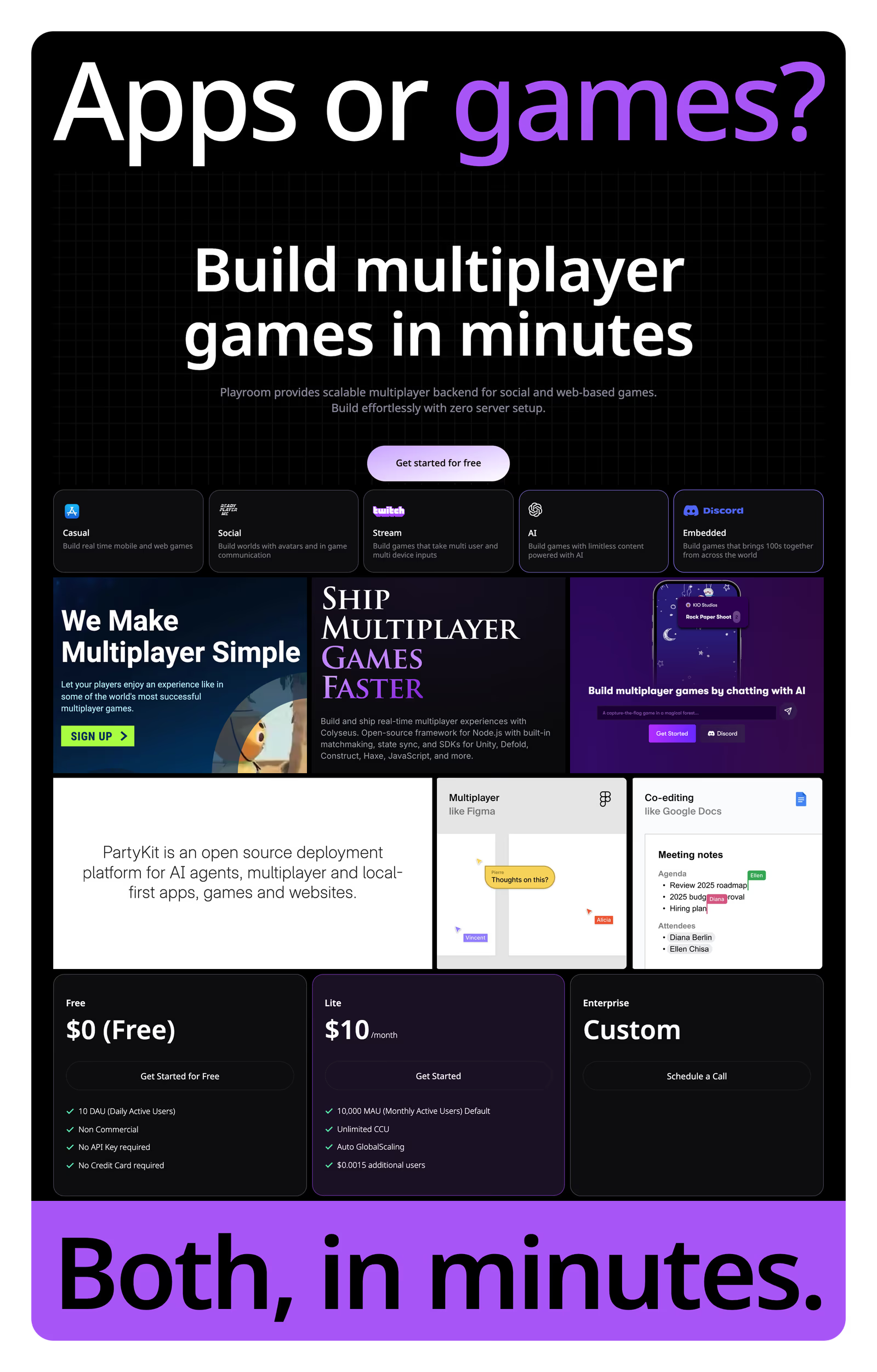
Playroom gives any app or game multiplayer in six lines of code. Its website still spoke only to game developers, while new builders arrived from apps and AI tools.
Playroom is a VC-backed Silicon Valley startup running a serverless multiplayer backend, with edge servers in 300+ cities across 120+ countries. We built its first website for game developers. By 2026 the people building on Playroom Kit had changed: collaborative apps, Discord Activities, and makers prompting Lovable and Replit. The homepage still opened on “Build multiplayer games in minutes”, and the developer portal couldn’t yet count and bill the active users that pricing was built on.
Research
An audit of our first site, five competitors and the pricing model.
We audited our games-era site against where Playroom Kit was heading: collaborative apps, Discord Activities and AI builders. We read Photon, Colyseus, Liveblocks, PartyKit and Rune. Game netcode sat on one side, app sync on the other, and AI builders were arriving on both. Then we traced pricing from the plan page to the invoice. Free counts daily users, Lite counts monthly ones, and the portal had to count both.
- 01
The site spoke only to game developers
So the hero names apps first. The use cases became creative, productivity and collaboration apps, AI games and Discord games.
- 02
New builders start from a prompt, not npm install
So three ready prompts open straight in Lovable, Replit and Base44.
- 03
Pricing counted players, but nothing showed them
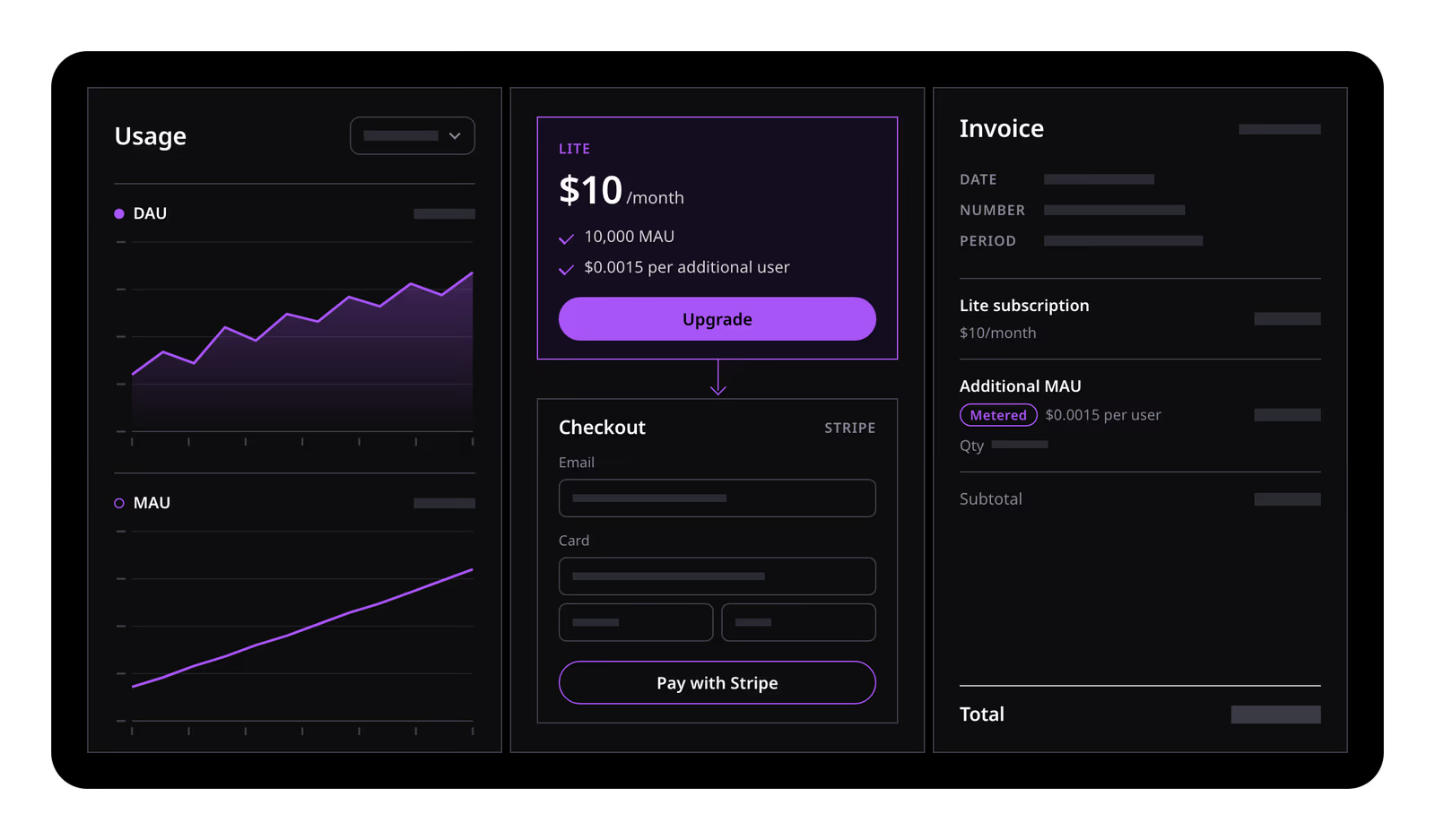
So the portal counts DAU and MAU per app and hands them to Stripe.
Content direction
Say apps out loud.
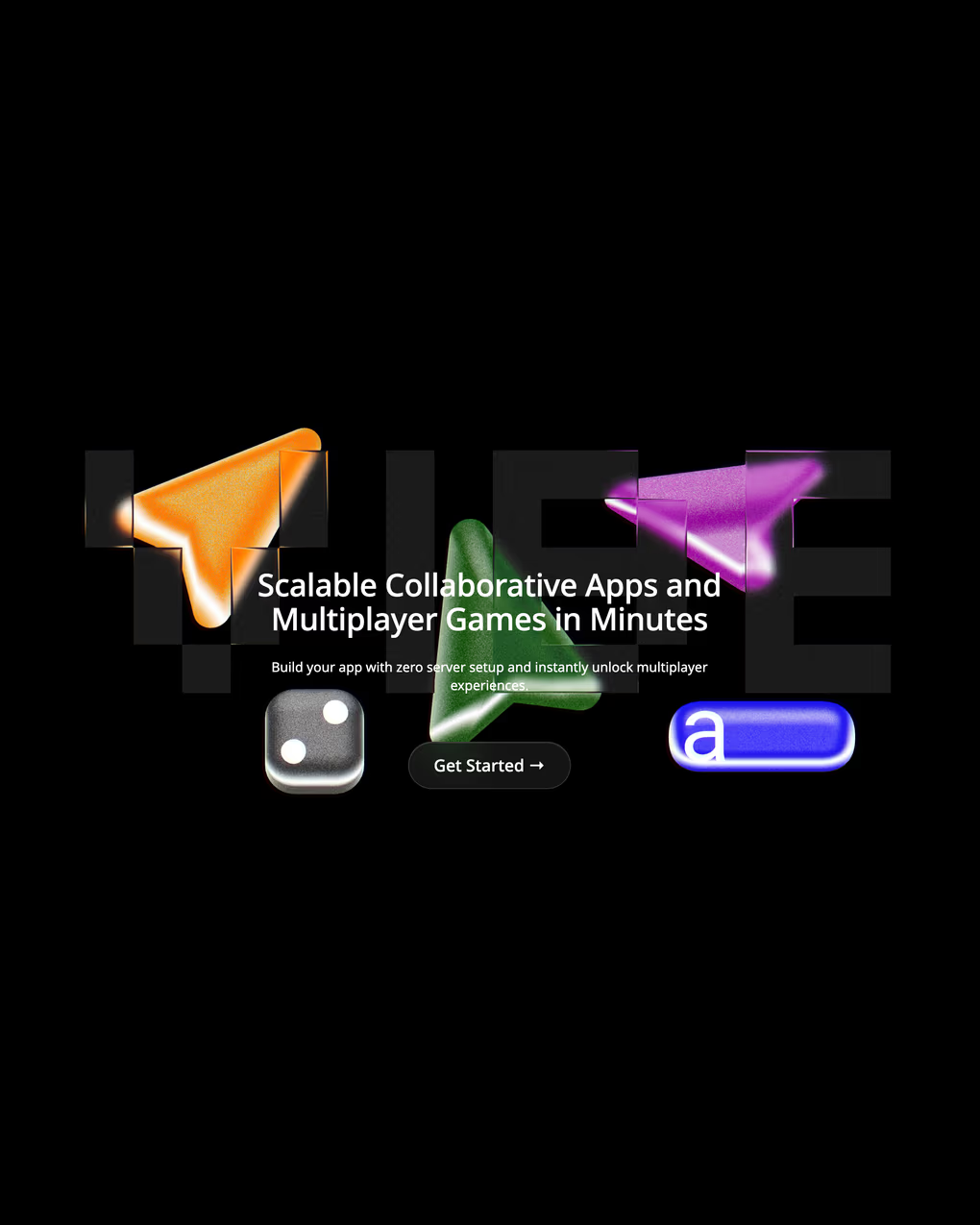
The headline moved from “Build multiplayer games in minutes” to “Scalable Collaborative Apps and Multiplayer Games in Minutes”. Use cases are named by what people make: live canvases, co-editing, live cursors. The engineering stays (six lines of code, zero backend, under 50ms), but now it backs up the promise instead of leading.
Sitemap
Four products, one way in.
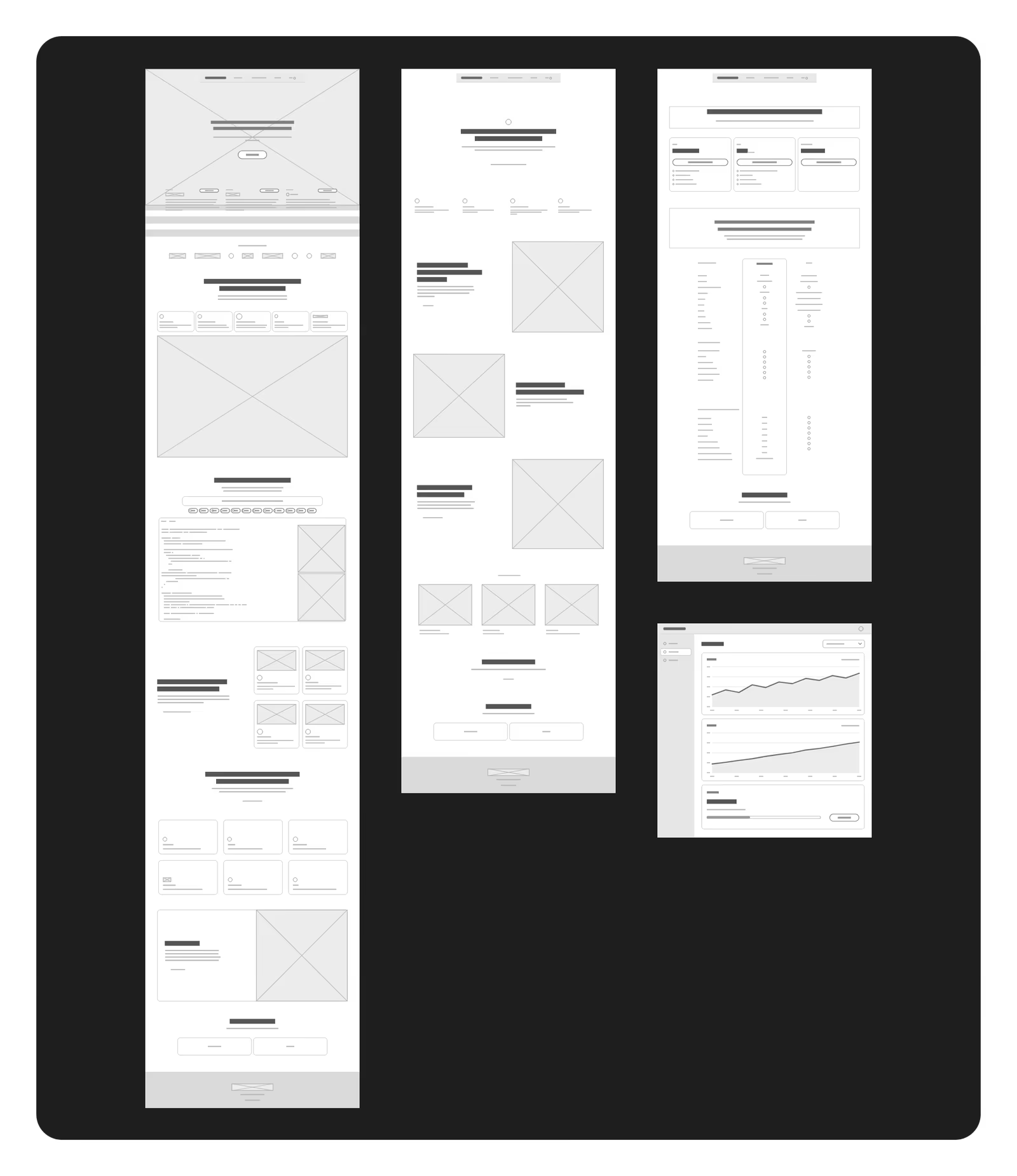
Features opens on Playroom’s four products, from the Multiplayer Kit to the Discord Kit. Documentation and Pricing sit beside them, and Resources hands out templates. The portal is part of the map, because pricing ends there: usage and billing live in Dev. Every route leads to the same first step, Get started.
Home
Features
Multiplayer Kit
Sync’d Modules
Persistence
Discord Kit
Documentation
Pricing
Free
Lite
Enterprise
Resources
Templates
Dev portal
Usage
Billing
Get started
Homepage
Pitch apps, prove engineering.
The first screen names apps and games together and hands new builders a prompt to start from. Everything below it is proof for engineers: who uses it, the code, the infrastructure and the modules.
01
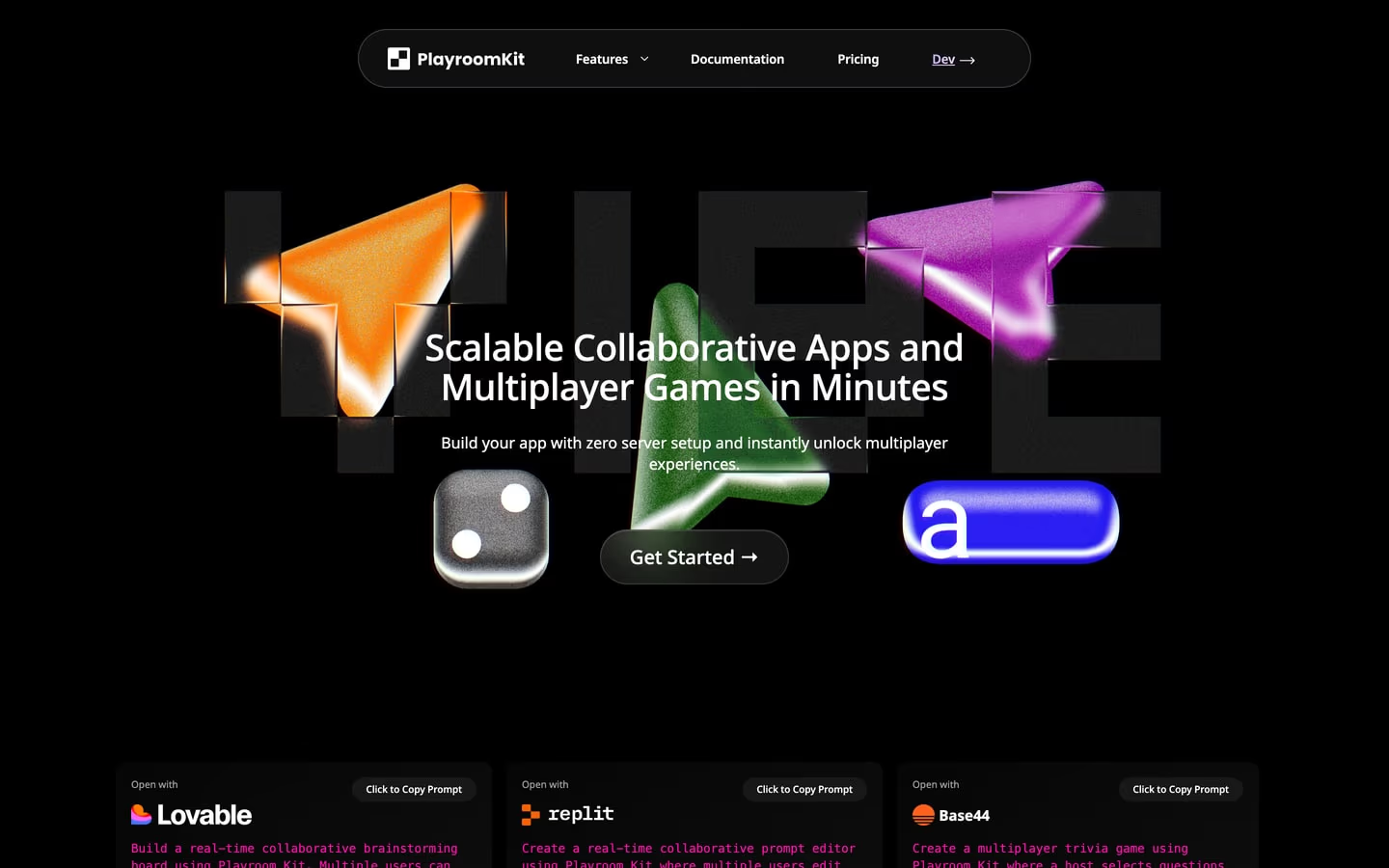
Collaborative apps and multiplayer games
The headline sits inside huge 3D letterforms, with a die, a cursor and a chat bubble floating around it. One button, Get Started, goes straight to the docs.
02
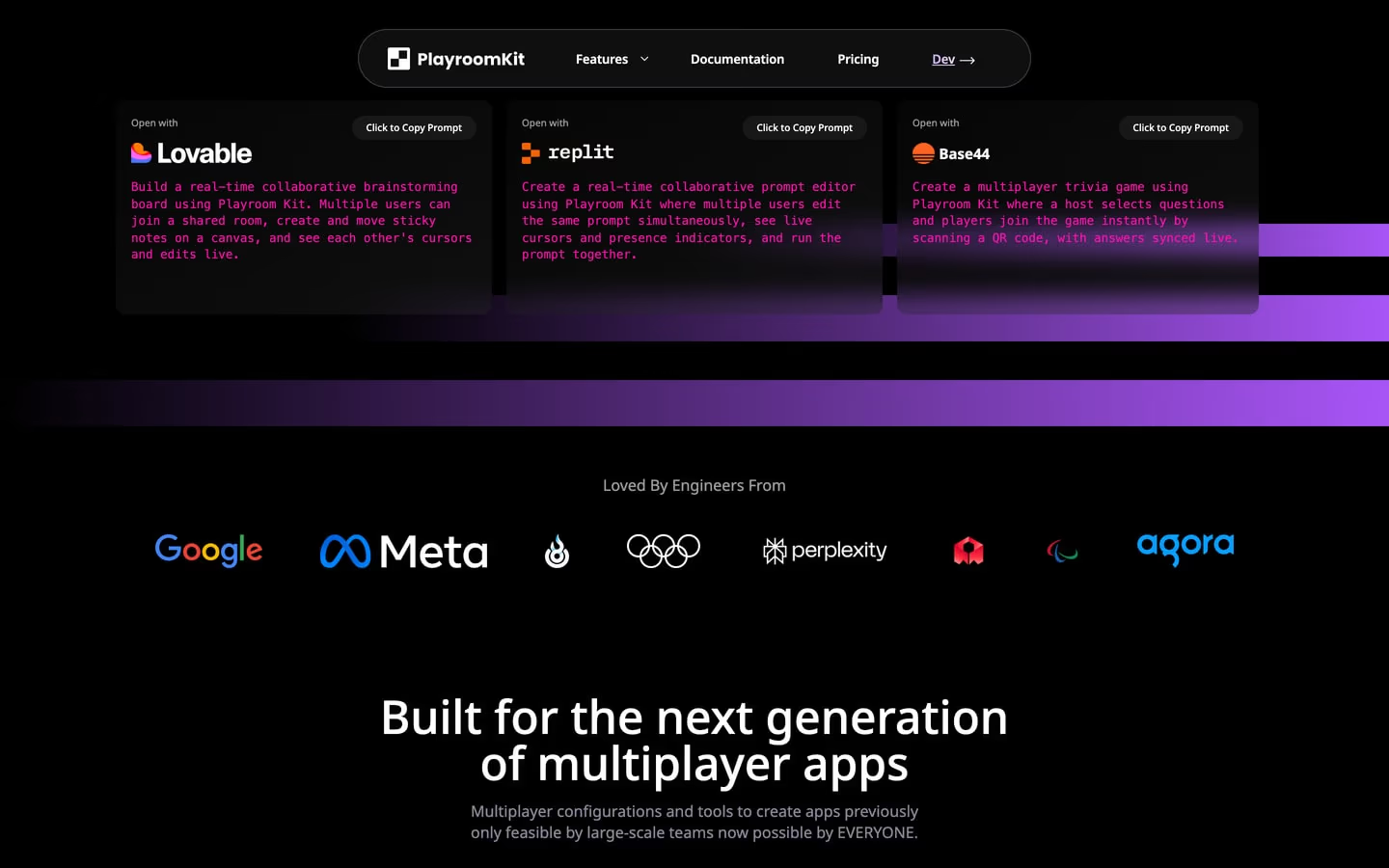
Open with Lovable, Replit, Base44
Three prompt cards build a brainstorming board, a prompt editor and a trivia game. Copy the prompt, or open it in the tool.
03
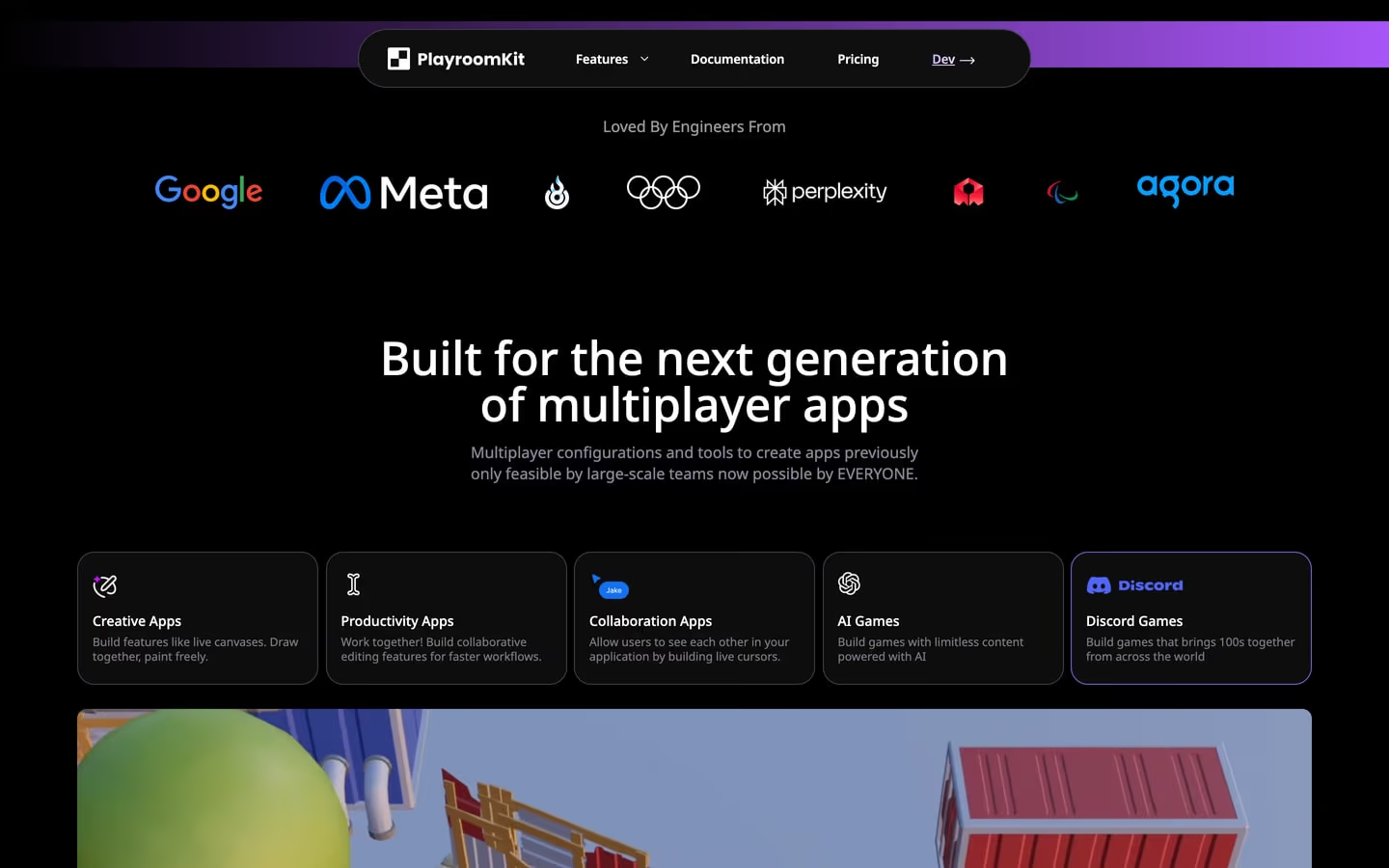
Loved by engineers from
Google, Meta, Perplexity, the Olympics and Agora, right under the prompts.
04
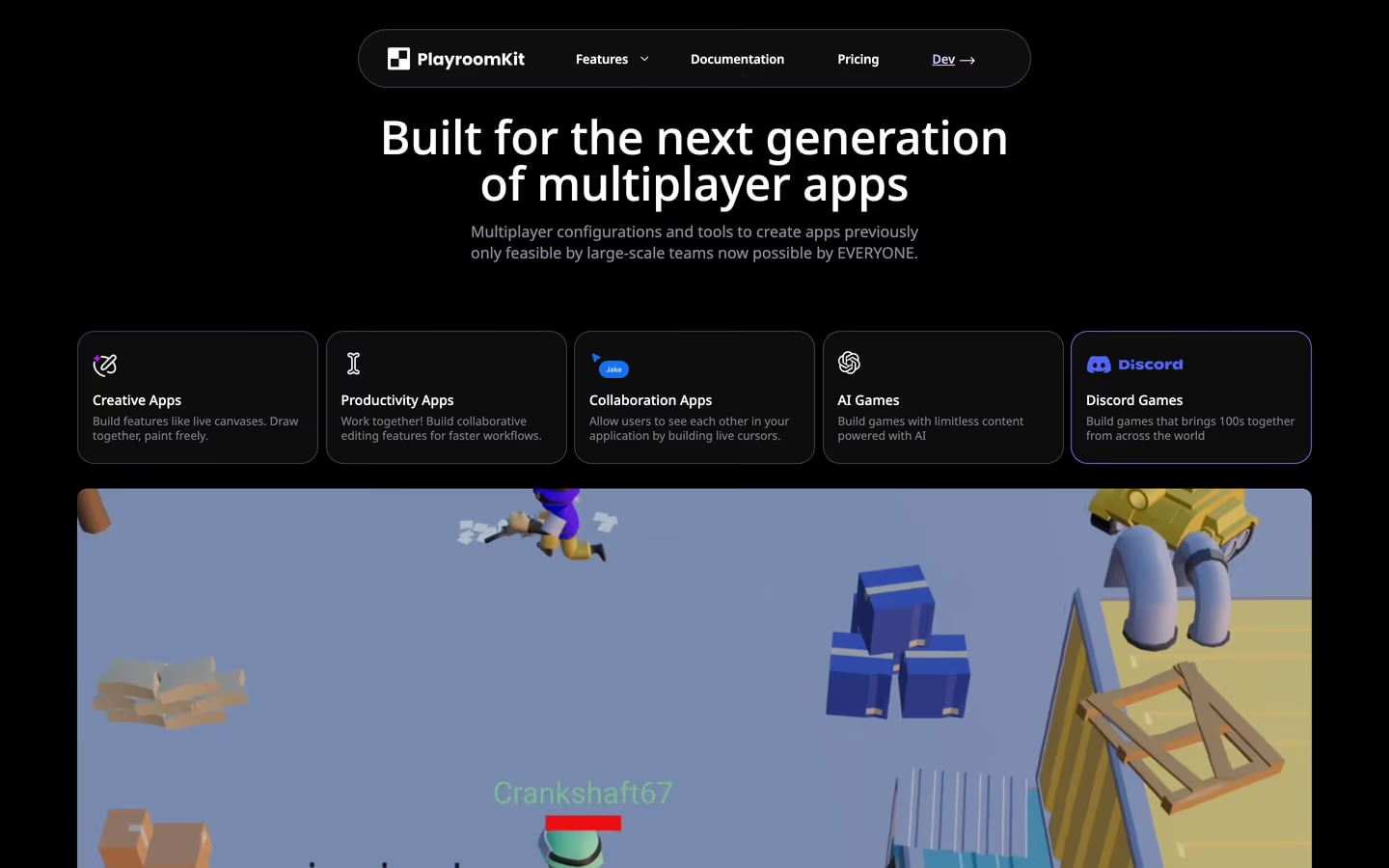
Built for the next generation
Five use cases, from live canvases to Discord games that bring hundreds together.
05
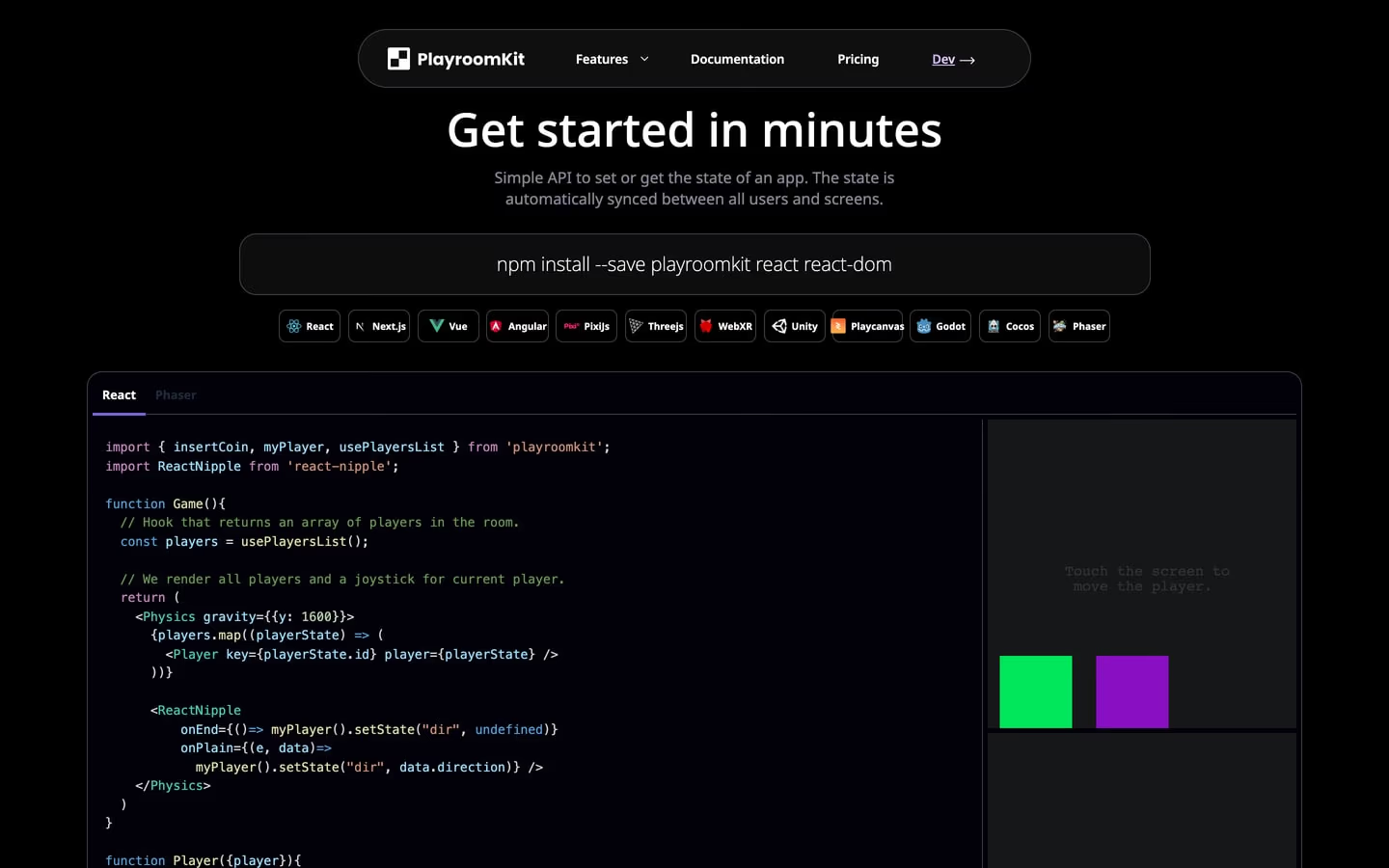
Get started in minutes
One install line and thirteen frameworks, from React to Unity and Godot. The code runs next to two player screens that move together.
06
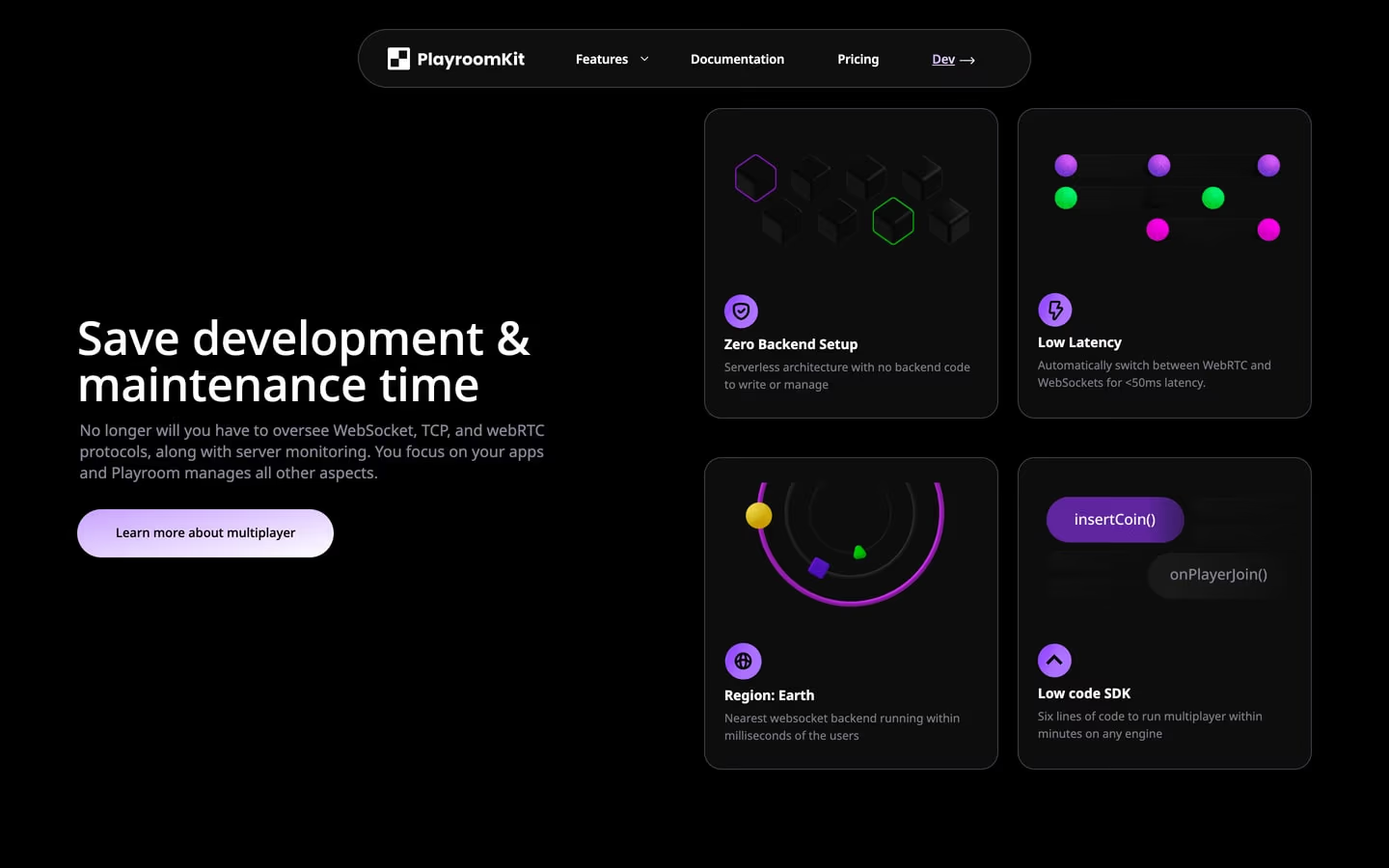
Save development and maintenance time
Four tiles cover what Playroom takes off a developer’s plate: zero backend setup, Region: Earth, under 50ms and six lines of code.
Portal
Billing that counts players the way pricing does.
Playroom charges by active users. Free covers 10 a day, and Lite covers 10,000 a month for $10, then $0.0015 a user. We updated dev.joinplayroom.com so each app counts its DAU and MAU, shows that usage to the developer, and hands it to Stripe, which runs the subscription and bills the overage.
Outcome